
Test specs. 2h → 20 min.*





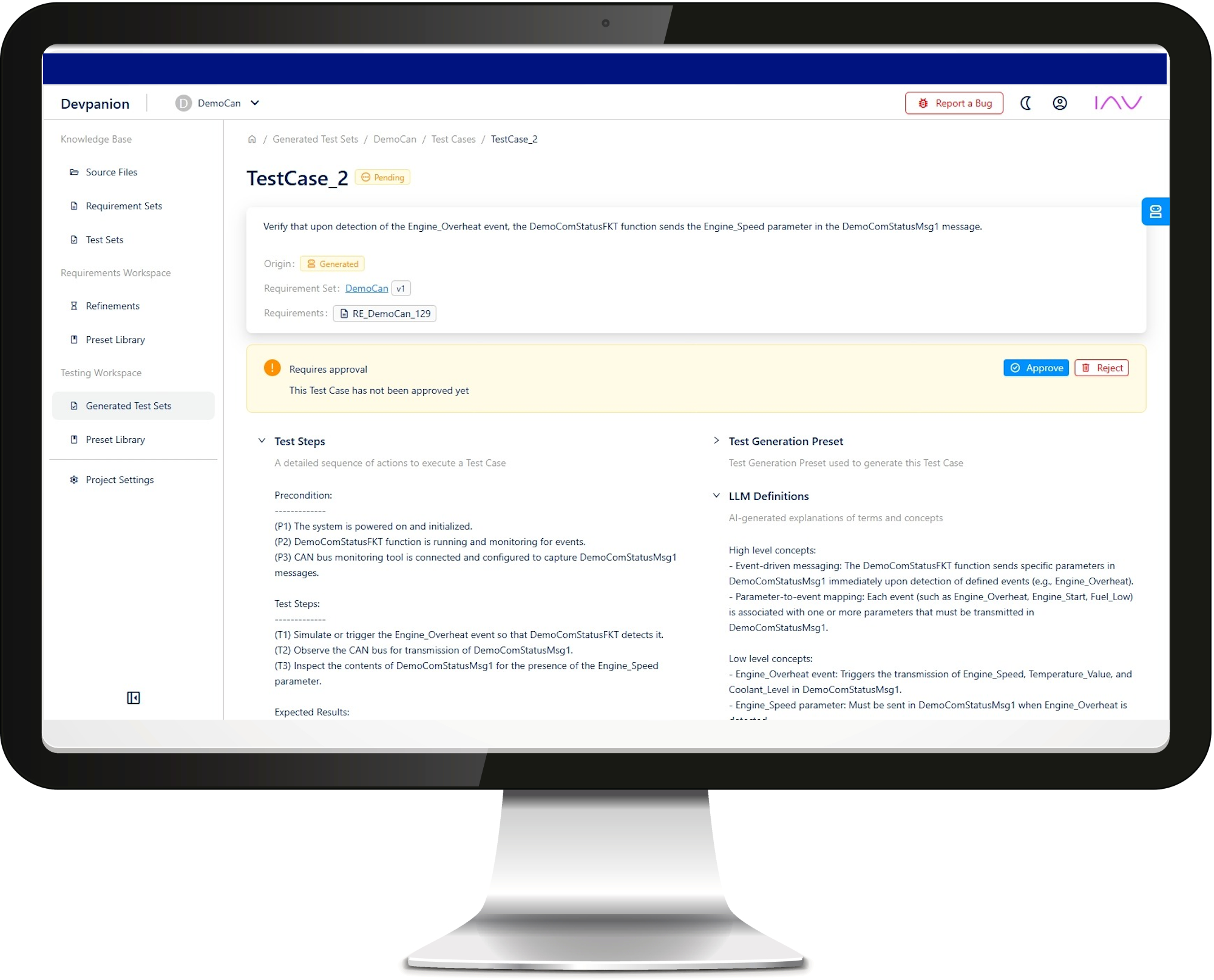
Take 1 minute. See tests get generated.
In 30 minutes, you'll know if it fits
No slides, no pitch deck. Just a live look at how IAV Devpanion generates test specifications from real requirements.

Sample data, live tests
What goes wrong, fixed

Your first results, same day
Book your live demo now!
30 minutes. Your 2-hour task, done in 20. Pick a slot.
Showcases
Your benefits
Repetitive structures are generated. You spend your time on the tests that actually need your expertise: edge cases, critical scenarios, domain-specific logic.
High quality of generated test cases, more than 80% were successful. After editing the preset it was even better.

Common questions
Yes. IAV Devpanion works with structured and unstructured inputs: E/E descriptions, A2L files, architecture docs, free-text specs. In the demo, we show you with sample data from real projects.
Day one. You can expect over 80% immediately usable test specs after preset tuning. Configure presets for your domain standards. The more you fine-tune, the better the outputs get.
Yes. IAV Devpanion reads E/E descriptions, A2L files, architecture docs, and more to propose complete test cases in minutes. You save 30 to 50% on multi-source test design.
No. Every generated test spec shows its source requirement and the reasoning behind it. You can verify any output in seconds. Explainable steps, sources, and reviewer gates at every point.
Yes. IAV Devpanion exports to your existing toolchain: DOORS, Codebeamer, Excel, or custom formats. No system replacement needed. Start with a pilot alongside your current workflow.
No strings attached
The demo runs on our sample data. No uploads, no prep work on your side. If it’s not a fit, we’re upfront about it. No follow-up calls, no email sequences.






Sources and Methodology
*/² Based on end-user feedback. Manual effort estimated at ~1-2 h, with IAV Devpanion ~20-25 min per requirement. Results vary by complexity and experience.
³ End-user feedback from an automotive testing project. “Usable” refers to reviewer-acceptable drafts; quality depends on preset tuning and input data quality. Human review remains required.
⁴ Self-reported time savings from user feedback and surveys (IAV Devpanion Testing). Results vary by task complexity, source quality, and user experience.
⁵ Self-reported from user feedback and surveys. At the start of new projects or for less experienced testers, time savings can exceed 50%. Results vary by project scope and prior experience.