IAV Mela
Challenge
Ensuring the safety of driver assistance systems, the specific Operational Design Domain (ADAS), and autonomous driving functions requires considering all possible scenarios within the specific Operational Design Domain (ODD). This encompasses the complex interaction of sensors, environmental conditions, and vehicle functions. This process is traditionally very time-consuming and places high demands on risk and relevance assessment. Regulations such as EU 2022/1426 and NCAP 2029 emphasize the need for evidence-based scenarios and tests under diverse and realistic conditions.
The IAV Solution
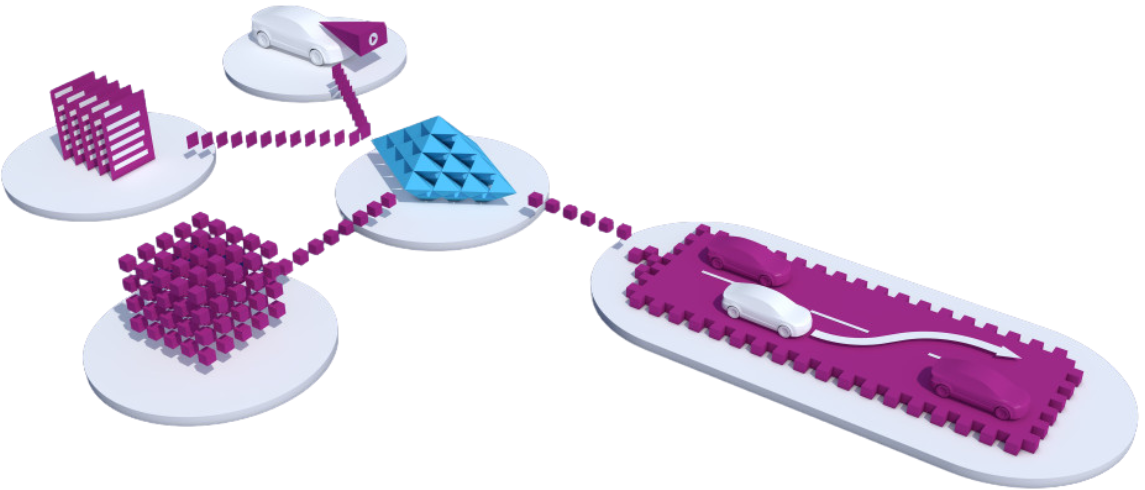
IAV Mela uses AI-based scenario generation to significantly accelerate virtual validation. The tool processes textual descriptions or video footage from real-world tests, identifies relevant scene elements using LLM and Vision LLM technologies, and generates simulation-ready, realistic scenarios from them.
Support for established standards such as ASAM OpenX and seamless integration with simulation environments make the entire validation process more efficient, scalable, and precise. IAV Mela supports specific requirements such as vehicle dynamics and chassis function test scenarios, thereby ensuring robust performance across a wide range of use cases for the entire system.

Additional Features
- Processing of logical or concrete scenario descriptions
- Analysis and categorization of real-world test videos using a combination of Vision-LLM and image processing algorithms
- Extraction of relevant parameters and scene elements
- Automatic generation of scenario previews and realistic virtual simulations
- Use of requirements, videos, or sketches as input (e.g., in combination with IAV Devpanion)
- Direct conversion into complete simulation model scenarios
Integration
Versatile applications: While IAV Mela is primarily designed for traffic scenarios, its capabilities extend far beyond ADAS/AD contexts and offer innovative solutions for various fields such as vehicle dynamics optimization, defense systems, mobile machinery, and much more. It also integrates seamlessly with modern simulation environments such as dSPACE ModelDesk/Aurelion or IPG CarMaker.
Compatibility
Extended toolchain for end-to-end validation: IAV Mela integrates seamlessly with IAV Devpanion, IAV Valdivia Sample, and other IAV AI tools to complete the workflow from requirements to test results and close the loop for continuous integration environments.
Standards
- Support for the ASAM OpenX standard
- Evidence-based scenarios for regulatory requirements (e.g., EU 2022/1426, NCAP 2029)

Your Inquiry

Prof. Reza Rezaei