
ISO 16750 and ISO 21498-2: What HV Test Facilities Must Cover
Anyone who validates automotive components knows ISO 16750. For decades, it has defined the environmental conditions and electrical requirements for vehicle components. It is embedded in practically every test facility at automotive suppliers.
In addition, ISO 7637-2 describes the requirements for immunity to electrical transients in the vehicle electrical system.
Both standards are designed for conventional onboard voltages: 12 V, 24 V, and in part 48 V. As long as a supplier develops only low-voltage components, this pair of standards is sufficient as the basis for electrical validation.
With the transition to high-voltage architectures (400 V, 800 V), this changes fundamentally. Inverters, onboard chargers, DC/DC converters, air-conditioning compressors, and HV-connected driver assistance systems have requirements. These requirements are not covered by ISO 16750 and ISO 7637.
These new requirements are governed by ISO 21498, specifically its Part 2, ISO 21498-2.
It extends the existing test landscape with the electrical requirements of the high-voltage domain. ISO 16750 therefore still applies. Every HV load has a 12 V or 24 V connection for control and safety-relevant equipment, so the full low-voltage tests, including climate, environmental, and service-life tests, are carried out for every HV load.
From ISO 16750 to ISO 21498-2: Where the requirements have shifted
ISO 16750 covers a broad spectrum: mechanical stress, climate, chemical influences, and electrical loads in the low-voltage range. ISO 7637 adds conducted transients to this. These are voltage peaks and interference pulses of the kind that occur in the 12 V and 24 V electrical system.
Different physical conditions apply to high-voltage components. The voltages are in the range of 400 to 1,500 V DC, and the currents reach three-digit ampere values. Added to this are effects such as voltage ripple at frequencies up to 150 kHz, which require their own test methods. These requirements can be neither generated nor evaluated with the test methods of ISO 16750 or ISO 7637.
ISO 21498-2 was developed for this field. It describes electrical tests specifically for HV components in the vehicle. In 2024, it was extended in a revision.
Among the additions is a short-circuit test. For ripple testing, the lower end of the frequency band was shortened from 10 Hz to 100 Hz. The amplitudes remain the manufacturers’ responsibility, since the vehicle manufacturer answers for the function of the vehicle.
For test facility managers and quality assurance, this means: ISO 16750 and ISO 7637 stay relevant for HV components too, and in some of the climate, environmental, and service-life tests, operation under HV voltage is even mandatory.
For the electrical validation of the HV components themselves, ISO 21498-2 is today the reference.
Which tests ISO 21498-2 specifically requires
In sections 6.2 to 6.12, ISO 21498-2 defines eleven electrical test types for HV components.
These include, among others:
- DC supply voltage variation within the operational range (6.2)
- Generated voltage slope (6.3)
- Immunity to voltage slope (6.4)
- Generated voltage ripple (6.5)
- Immunity to voltage ripple (6.6)
- Overvoltage (6.7)
- Undervoltage (6.8)
- Voltage offset (6.9)
- Generated load dump (6.10)
- Immunity to load dump (6.11)
- Short circuit (6.12)
That is the core. In practice, OEM-specific standards add further tests.
VW 80300, for example, defines a total of 18 EHV tests (EHV-01a/b to EHV-17). Many of them build on ISO 21498-2 but tighten parameters such as slew rate or endurance.
Mercedes’ MBN 11123 maps ISO 21498-2 in its own structure (sections 7.2 to 7.11), likewise with OEM-specific adaptations.
In total, this results in a test scope of 15 to 18 different electrical tests for a Tier 1 supplier qualifying HV components for several OEMs. Those who cover only ISO 21498-2 meet the international baseline requirement. Those who supply VW, Mercedes, or BMW additionally have to master the respective OEM derivatives.
Where OEM standards go beyond ISO 21498-2
The OEM standards are not copies of ISO 21498-2 with a different cover sheet. They specifically tighten individual parameters.
Three examples:
Slew rate at load dump: ISO 21498-2 requires 250 V/ms. VW 80300 requires up to 3000 V/ms for EHV-10. That is a factor of 12. A test setup that meets the ISO requirement may fail the VW specification completely.
Additional test types: VW 80300 contains tests that do not appear in ISO 21498-2 at all: HV precharge (EHV-04), HV overcurrent (EHV-12), ON/OFF endurance test (EHV-14), and function of HV interlock, service disconnect, and crash signaling (EHV-15).
Added to this is voltage offset (EHV-11). This test does also exist in ISO 21498-2, but VW 80300 interprets it quite differently. The implementation is more demanding and places entirely different requirements on the test equipment.
Timing requirements: For Generated Load Dump, MBN 11123 specifies a switch-off time of 100 µs. This places different requirements on the switching speed of the HV disconnection than the ISO variant.
For quality assurance, this means: ISO 21498-2 conformity alone is usually not sufficient for a complete release. The OEM-specific standards have to be tested separately and accounted for in the test planning.

What this means for the test infrastructure
A test facility that wants to validate HV components to ISO 21498-2 and the relevant OEM standards needs equipment that goes beyond what is in use for ISO 16750 or ISO 7637.
In concrete terms, the following requirements arise for the test setup:
- An HV power supply in the range of 400 to 1,500 V DC with sufficient power.
- A ripple generator whose current matches the respective test task, at frequencies up to 150 kHz. The required current depends on the test object: component tests get by with less, battery tests can demand considerably more.
- Measurement equipment that fits the measurement task. The standards require sampling rates of 1 MS/s, at most 2 MS/s. Higher rates mainly generate additional data that has to be stored and processed.
- An onboard network simulation with a defined internal resistance.
- A safety architecture that meets the requirements for HV test benches.
Added to this is a practical challenge that is underestimated in many test facilities. With 15 to 18 tests, the test object should ideally be connected once and run through all tests without rewiring. Every rewiring changes the electrical boundary conditions and creates measurement uncertainties that are hard to explain in an audit.
Anyone who wants to avoid this needs an automatic switching box between the various test modes.
We operate such an integrated setup in our test facility in Stollberg, including automatic signal routing. The test object is connected once and runs through the relevant tests without rewiring, for VW 80300 for example 15 of 18 tests. Anyone who would like to know how this proves itself in daily operation can see it on site.
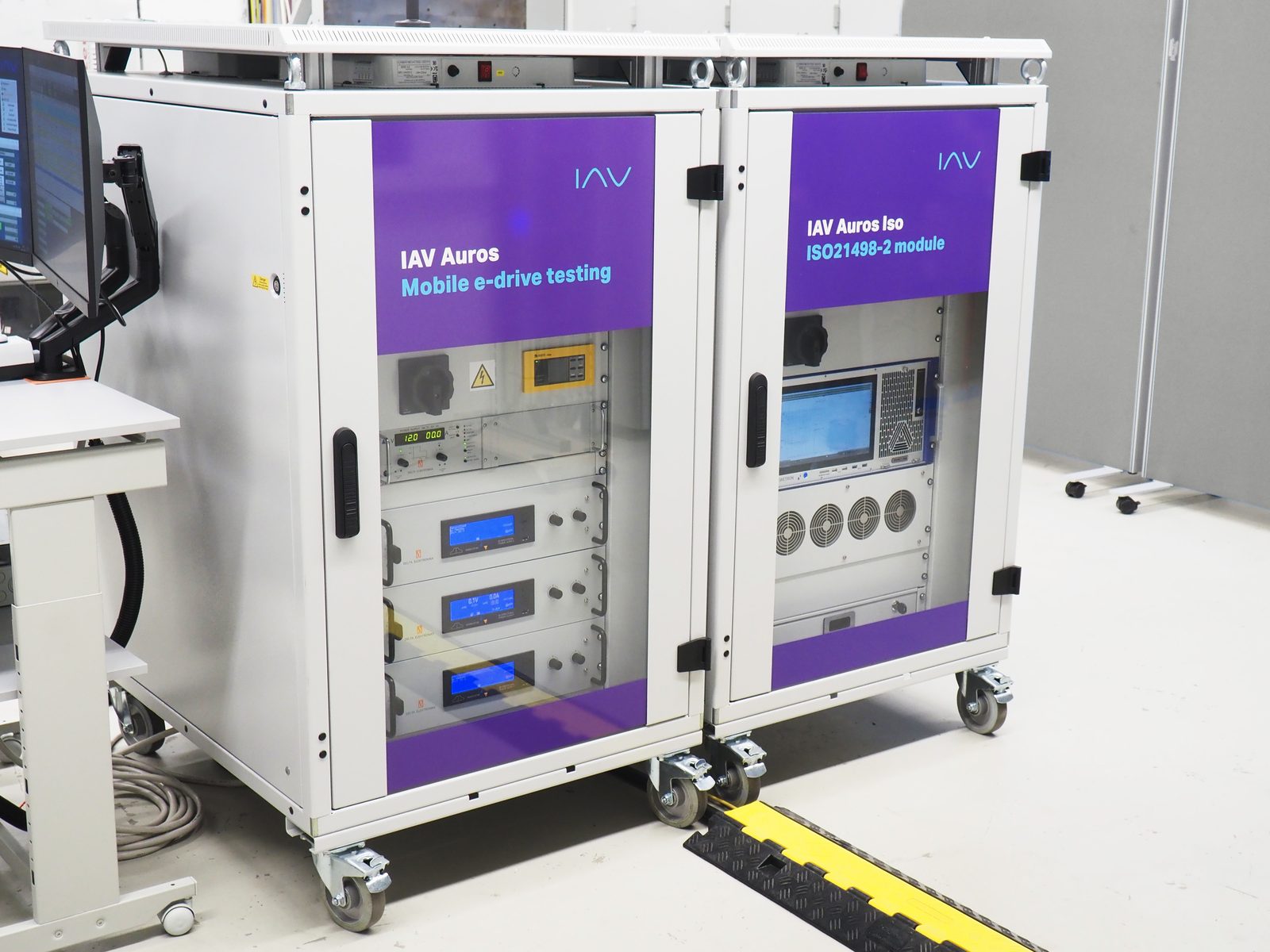
Integrated setup at the Stollberg test facility: IAV Auros as the base, IAV Auros Iso as the module for testing to ISO 21498-2.
In-house capacity or external outsourcing?
This question is on the agenda for many test facility managers as soon as HV components enter the portfolio. The answer depends on a few but decisive factors.
External test service providers typically charge €60,000 to €70,000 for a complete HV test run to ISO 21498-2. For a single test object in a single sample phase, that can be economical. In practice, however, a Tier 1 supplier rarely develops only one product in a single sample phase. An inverter goes through A, B, and C samples, an air-conditioning compressor likewise, plus the OBC and DC/DC converter.
From about six test runs per year, the external costs add up to €360,000 to €420,000 annually. In this range, in-house test capacity begins to pay off. The investment in an integrated test setup is in a similar order of magnitude and can be used over many years.
Beyond cost-effectiveness, there are three further drivers that are missing from a pure cost calculation.
- The first is schedule independence: anyone who outsources stands in the service provider’s queue. When the OEM wants to see results in three months, this dependency is a risk.
- The second is IP protection: every external test run requires the development status of the component to be disclosed. For components still in development, this is a sensitive topic for many suppliers.
- The third is the multiple use of the hardware: the electrical tests call for high-quality equipment that can also be used for functional tests whenever it is not occupied with electrical testing. In this way, an investment once made is spread across several purposes and rarely stands unused in the test facility.
For Tier 1 suppliers with fewer than six test runs per year and a manageable component portfolio, external outsourcing can still be the right choice. Those who continuously qualify HV components for several OEMs are usually better off with in-house capacity.
Which path is the right one for a specific component portfolio depends on a few figures: number of test objects, sample phases, OEM requirements. We would be glad to go through this calculation together with you.
What a test facility has to cover at a minimum today
Anyone setting up their test facility for the electrical validation of HV components should take the following points as orientation:
Standards coverage: ISO 21498-2 as the international basis. Plus the OEM standards of the customers being supplied (VW 80300, MBN 11123, BMW GS 95023, or comparable). ISO 16750 and ISO 7637 remain relevant in parallel for low-voltage portions and environmental tests.
Test scope: At least the eleven test types of ISO 21498-2 including the short-circuit test. For VW suppliers, the VW-specific EHV tests are added; for Mercedes suppliers, the MBN equivalents.
Test infrastructure: HV supply up to 1,500 V DC, ripple generation up to 150 kHz, measurement equipment with sufficient bandwidth, onboard network simulation, safety technology. Ideally as an integrated setup that enables all tests without rewiring.
Documentation:Automated test reports in the format that the respective OEM requires. Complete traceability of the measurement data for audits.
The standards landscape for HV components is complex but manageable once you know the structure. ISO 16750 and ISO 7637 remain the basis for the low-voltage range. ISO 21498-2 is the foundation for the high-voltage range.
Anyone searching for ISO 21498 encounters these very requirements. The OEM standards build on them and tighten in targeted ways. Anyone who can map these three levels in the test facility is set up for the current release requirements.

About the author
Enrico Neumann, Head of Product Management at IAV, responsible for the IAV Auros Iso product
The practical experience described in this article comes from the daily operation of the IAV test facility in Stollberg. There, our HV test system has been in use for customer projects for years.
enrico.neumann@iav.de
Tel.: +49 5371 80-51724
Book an appointment here