
Autonomous and highly automated vehicles rely on robust and precise sensor technology. This applies to passenger cars as well as commercial and work vehicles, agricultural and rail vehicles, as well as UGVs and special applications. Cameras, IR cameras, LiDAR, radar, and other sensor systems form the basis for reliable environmental perception and functional safety.
It is crucial that the sensors have an unrestricted view of their surroundings at all times. Only then can they reliably perform their tasks even in rain, splash water, dust, mud, or snow. Without reliable sensor cleaning, image quality, sensor performance, and the availability of automated driving functions significantly decrease.
IAV’s sensor cleaning system addresses this challenge with an integrated approach of AI-based contamination detection and targeted, automated cleaning of exposed sensors. In this way, the availability, functionality, and operational safety of automated driving functions are sustainably supported both on-road and off-road.
Modular sensor cleaning system for different vehicle platforms
IAV is developing a modular sensor cleaning system that includes AI-based modules for real-time contamination detection, components for targeted camera and sensor cleaning, and scalable system architectures for different vehicle platforms. The modular design allows for flexible adaptation to sensor arrangement, application profile, and quantity. Cameras, IR cameras, and LiDAR systems are among the covered components.
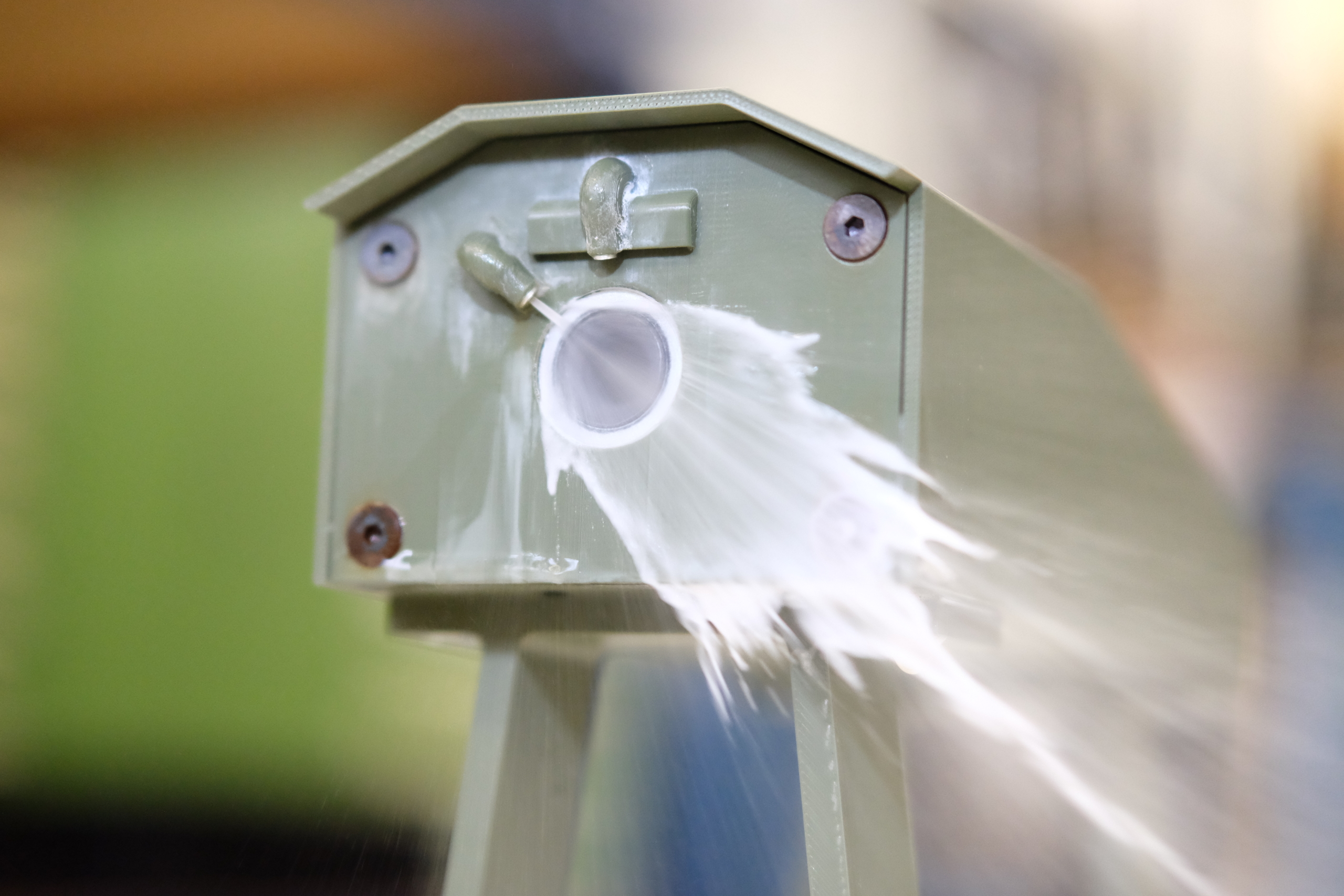
Functionally relevant contaminants are reliably detected, and appropriate cleaning measures are initiated if necessary. Coordinated components for detection, actuation, and media supply ensure that sensors remain available even under changing environmental conditions. The individual modules can be scaled, combined, or customized according to the application.
Engineering, AI, and Integration from Pre-Development to Series Production
The use of camera and sensor cleaning systems requires close coordination with vehicle architecture, sensor technology, and application scenarios. IAV complements the system toolkit with comprehensive engineering and integration services. These include the definition of system requirements, the design of the cleaning architecture, and the analysis of contamination and cleaning effectiveness using 3D CFD simulations. This results in application-optimized solutions from initial functional prototypes to near-series system concepts.
The AI-based contamination detection analyzes sensor data from camera and LiDAR systems and identifies perception impairments early on. Different image and signal artifacts are detected and transformed into situation-dependent cleaning strategies. In multisensory architectures, cross-sensor evaluation further increases the robustness and stability of the systems, thereby creating a central prerequisite for automated and autonomous driving functions.
A mobile demonstrator makes the interaction between contamination detection and sensor cleaning visible under realistic conditions and supports the joint evaluation of system concepts up to near-series applications.
Contact
Kai-Alexander Marx
kai-alexander.marx@iav.de
LinkedIn