IAV Valdivia Sample
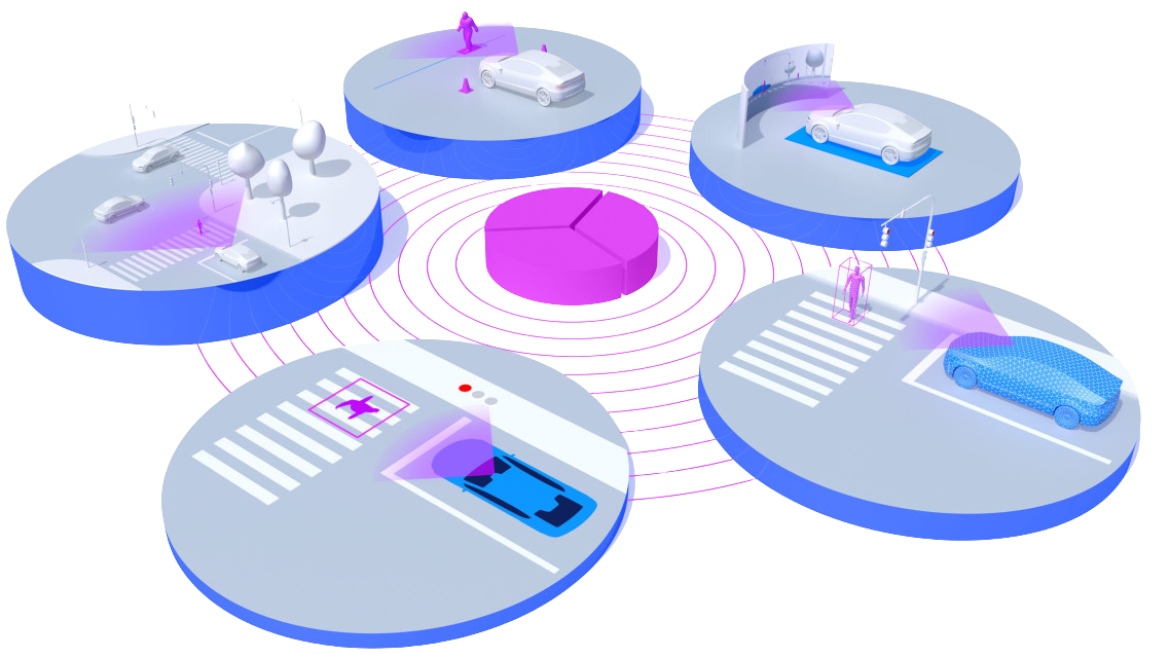
Automated vehicles must be able to handle countless scenarios safely. However, given the multitude of potential situations, it is not possible to test them all. This is where IAV Valdivia Sample comes in. The software tool supports the targeted selection of test scenarios and helps to reliably test automated driving functions in the areas of ADAS and AD. With this approach, customers can save up to 80% in testing costs (exemplary calculation based on research results).
How do you benefit from this?
- Generate traceable results: IAV Valdivia Sample uses a scientifically sound approach with state-of-the-art probabilistic ML models. This enables IAV Valdivia Sample to offer a transparent process and traceable decisions.
- Save time and reduce costs: The software offers the possibility to reduce your testing effort by up to 80% through fewer simulations and less calculation time and licenses. This leads to increased efficiency and cost savings.
- Whether in the cloud or locally – just get started! IAV Valdivia Sample is designed to be integrated into fully automated test environments (SiL or HiL) via REST APIs. The solution is cloud-ready and can be used as software as a service.
- Countless use cases for numerous industries: Originally designed for use in the AD sector, the tool can be used wherever efficient modeling methods are required for the development or approval of complex systems – e.g., in the energy industry or aviation.
How does it work?
IAV has developed IAV Valdivia Sample, a software program that uses statistical techniques and artificial intelligence to generate test scenarios. This process is iterative and adapts independently to the previously unknown system and its characteristics – because every system has its own weaknesses that need to be uncovered.
- Generating different scenarios: The test scenarios are first generated using statistical techniques to achieve broad coverage and take into account a wide variety of scenarios.
- AI comes into play: The results of these tests are then analyzed using AI to determine which characteristics of the scenarios, either alone or in combination, favor critical outcomes. This could be, for example, the interaction of low sun and wet roads.
- Iterations for a better understanding: Finally, critical scenarios are generated iteratively for the system and their data is analyzed again. With each iteration, more weaknesses can be uncovered and the system can be better understood.
Using artificial intelligence, this method goes beyond traditional optimization and experimental design methods. It is characterized by the use of probabilistic metamodels and repeated, adaptive experimental design (adaptive importance sampling). Probabilistic models can ultimately be used to calculate the probabilities of critical scenarios, which provides a measurable basis for the approval decision for safety-critical systems.
Better together. Our partners.



Contact
"*" indicates required fields