
Testing VW 80300, MBN 11123, BMW GS 95023: Make or Buy?
The OEM wants to see results in three months. The external test lab has weeks of lead time. The in-house team started putting together a test setup a year ago and is still far from finished.
Many Tier 1 suppliers that have to qualify HV components for OEMs know this situation.
This article classifies the most important OEM standards and compares three ways to meet the test requirements. Beyond that, it provides the figures needed for a well-founded make-or-buy decision.
Which OEM standards are relevant for HV components
Anyone who supplies HV components for German automotive manufacturers encounters three central OEM standards for electrical testing:
VW 80300 defines 18 EHV tests (EHV-01a/b to EHV-17) for high-voltage components. The basis is the international ISO 21498-2. The slew rate at load dump (EHV-10) with high steepness is 3000 V/ms. ISO 21498-2, by contrast, sets 250 V/ms. In addition, VW 80300 contains tests that do not appear in the ISO at all.
These include:
- HV precharge (EHV-04)
- HV overcurrent (EHV-12)
- function test of HV interlock, service disconnect, and crash signaling (EHV-15)
MBN 11123 is the Mercedes-specific variant. It maps ISO 21498-2 in sections 7.2 to 7.11. OEM-specific adaptations are added. For Generated Load Dump (section 7.10), for example, MBN 11123 requires a switch-off time of 100 µs.
BMW GS 95023 is the BMW-specific standard for the electrical properties and electrical safety of HV components. For the general electrical requirements of E/E components in the low-voltage range, BMW GS 95024 applies instead. The specific test requirements must be coordinated with the OEM on a case-by-case basis. The specifications are less openly accessible than at VW or Mercedes.
For context: these OEM standards address the high-voltage range. Upstream of them are the supply specifications LV 123 and LV 124. LV 123 covers the high-voltage components. LV 124 covers the low-voltage components.
Both arose as joint specifications of the German automotive manufacturers in the early phase of electromobility. For the high-voltage range, LV 123 has mostly transitioned to ISO 21498-2. Manufacturers also use their own factory standards.
At BMW, the low-voltage and E/E range is mapped in the factory standard GS 95024, which builds on LV 124. The HV-specific electrical tests additionally require VW 80300, MBN 11123, or BMW GS 95023 on the basis of ISO 21498-2.
Three ways to meet the standards: time, cost, and risk compared
There are three ways for Tier 1 suppliers to test their HV components to VW 80300, MBN 11123, or BMW GS 95023.
Path 1: External outsourcing: An external test service provider carries out the tests. The typical costs are €60,000 to €70,000 per complete test run. The lead time is several weeks, depending on the service provider’s workload. For a single test object in a single sample phase, this can be the fastest entry point.
As soon as several products are tested in several sample phases, the costs add. At six test runs per year, that comes to €360,000 to €420,000 annually.
It should be borne in mind that every external run discloses the development status of the component. And the scheduling lies with the service provider.
Path 2: In-house build: The in-house test team buys each component. These include the HV source, ripple generator, measurement equipment, and safety technology. They then build a test setup. On paper, this looks more cost-effective. In the real world, integrating the individual components into a standard-compliant overall system can take months to years.
The challenges lie in EMC tuning, measurement equipment integration, and automation across all test modes. We are aware of cases in which suppliers started with a budget of €200,000. After two years, they were still unable to deliver standard-compliant results.
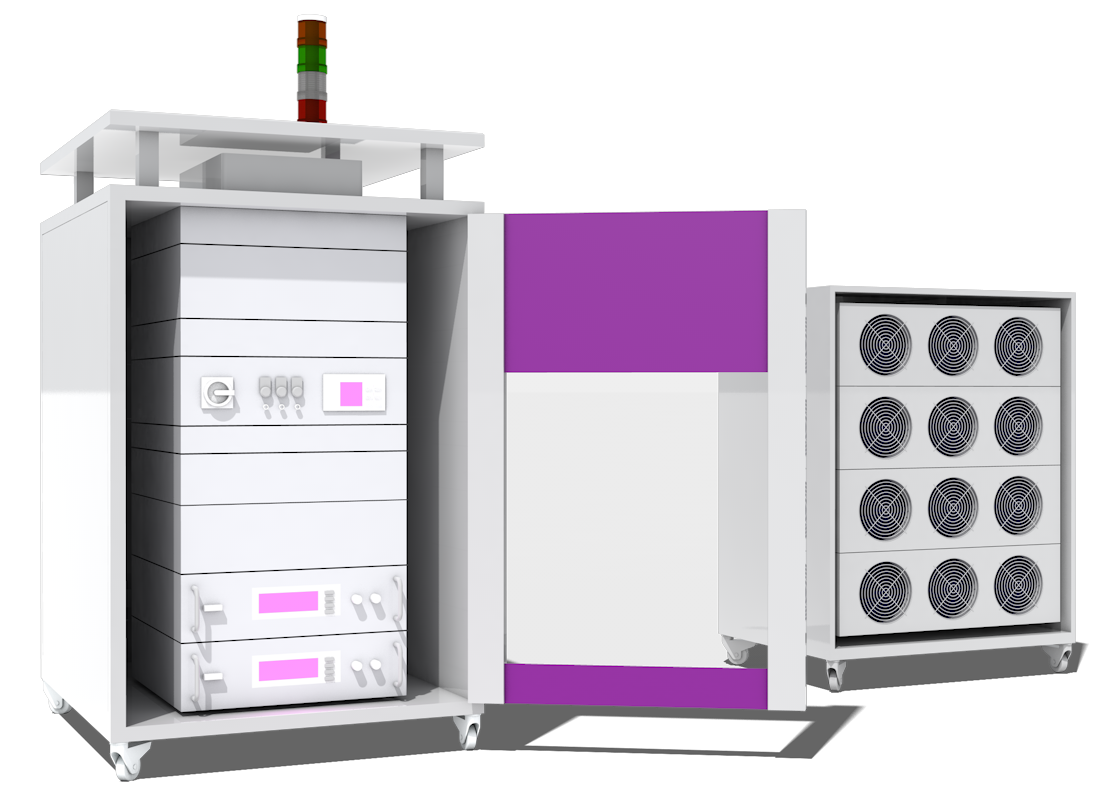
Path 3: Integrated complete system: A fully tuned system that combines the following in a single setup:
- HV supply
- ripple generator
- measurement equipment for transient measurement traces
- automation
- safety
IAV Auros Iso is such a system. In the standard configuration, it costs €499,000 as a complete system.
- 15 of 18 tests to VW 80300 are covered.
- All tests to MBN 11123 are included (sections 7.2 to 7.11).
- The eleven test types to ISO 21498-2 are covered.
The delivery time is around six months.
For comparison: a ripple generator alone (for example the Ametek Ripple NX) costs €463,000 plus calibration. This includes neither HV supply nor automation, safety, or measurement equipment.
A brief note on positioning versus the competition: the market offers established premium complete systems above €500,000. These systems are stationary and have long delivery times. Or individual building blocks such as ripple generators that a team has to assemble into a system itself.
A mobile, fully integrated system in this price class is the exception.

What matters in the decision
The right choice depends on three factors:
Number of test runs per year: With fewer than six runs per year, external outsourcing is usually more economical.
From about six runs, the calculation begins to turn: the annual external costs (€360,000 to €420,000) then move into the order of magnitude of the system investment, which can be used over several years. An in-house system has fully paid for itself after about seven to eight external test runs.
Repeat frequency and time pressure: Anyone who continuously develops HV components has several products in parallel sample phases. Each product needs test results by a fixed OEM deadline. When the OEM expects results in three months, schedule independence is a hard factor. In-house test capacity eliminates the queue at the service provider.
OEM documentation format: Every OEM expects test results in a specific format. With external outsourcing, the documentation format must be coordinated. With an in-house build, the reporting chain must be set up yourself.
An integrated system with automated reporting delivers the data directly in the required format. For quality assurance and for audits, this makes a considerable difference.

What is often overlooked in the investment decision
Three points fall by the wayside in many investment proposals.
IP protection: Every external test run requires the component’s current development status to be disclosed to the service provider. For components in early sample phases, this is a sensitive topic.
Building expertise: In-house test capacity means in-house know-how within the team. With external outsourcing, the test competence stays with the service provider.
Supply chain and operating costs: With an integrated system and a supply chain in Germany and Switzerland, customs risks are removed. Complex international coordination is also eliminated. Operating costs are limited to electricity (63 A CEE connection) and active air cooling. No cooling water is required.
Summary: when which path fits
Anyone below six test runs per year with a manageable component portfolio runs economically with external outsourcing. Anyone who continuously qualifies HV components for several OEMs and is under time pressure needs in-house capacity.
The question is then whether the in-house build is realistically achievable within the necessary timeframe. Or whether an integrated system leads to results faster.
We have been testing to VW 80300, MBN 11123, and ISO 21498-2 in our test facility in Stollberg for years. For anyone who would like to get an impression: we are glad to invite you to a test bench visit.
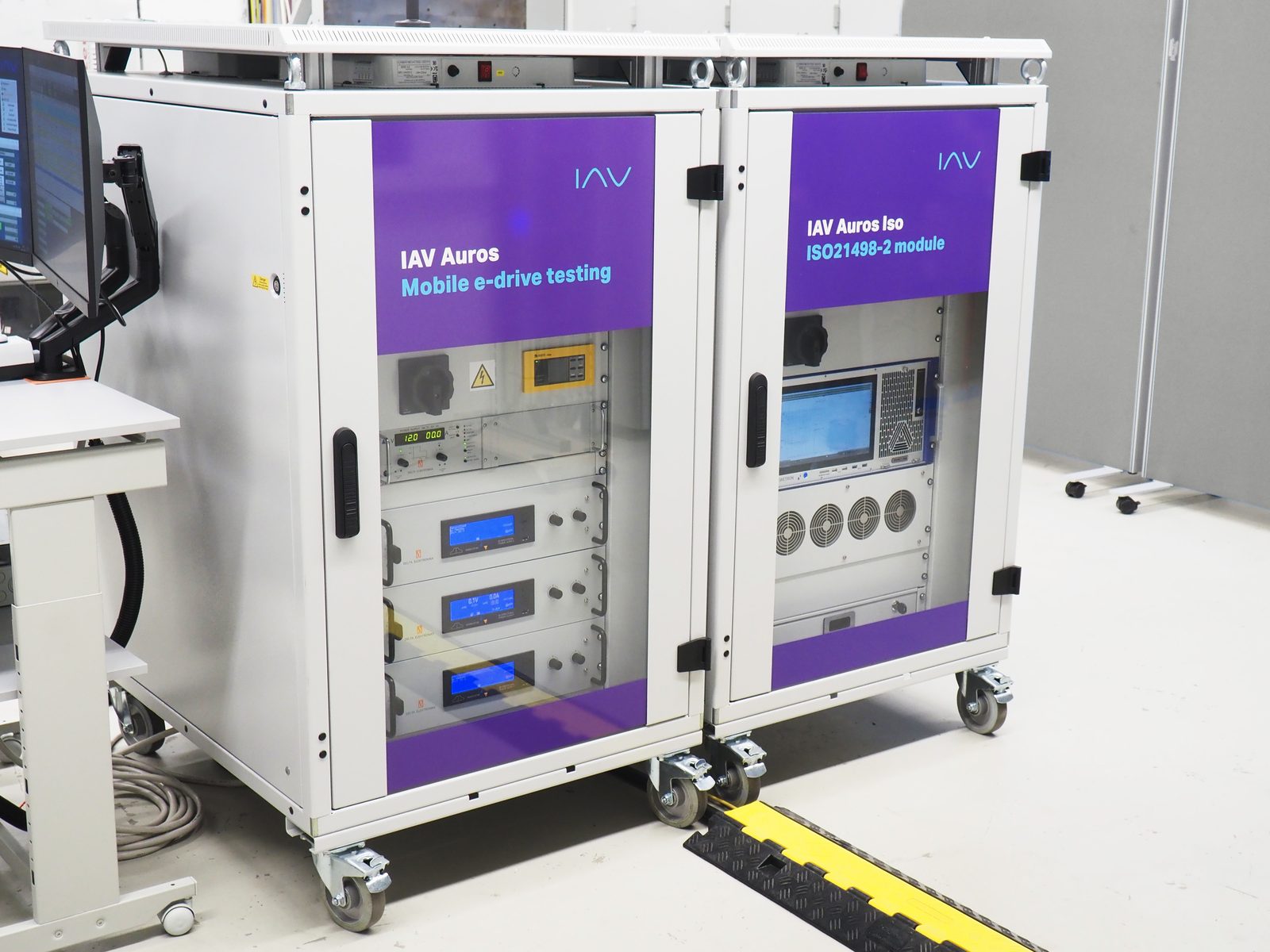
The integrated complete system: IAV Auros as the base, IAV Auros Iso as the module for testing to ISO 21498-2 and the OEM standards.
About the author
Enrico Neumann, Head of Product Management at IAV, responsible for the IAV Auros Iso product
The practical experience described in this article comes from the daily operation of the IAV test facility in Stollberg. There, our HV test system has been in use for customer projects for years.
enrico.neumann@iav.de
Tel.: +49 5371 80-51724
Book an appointment here